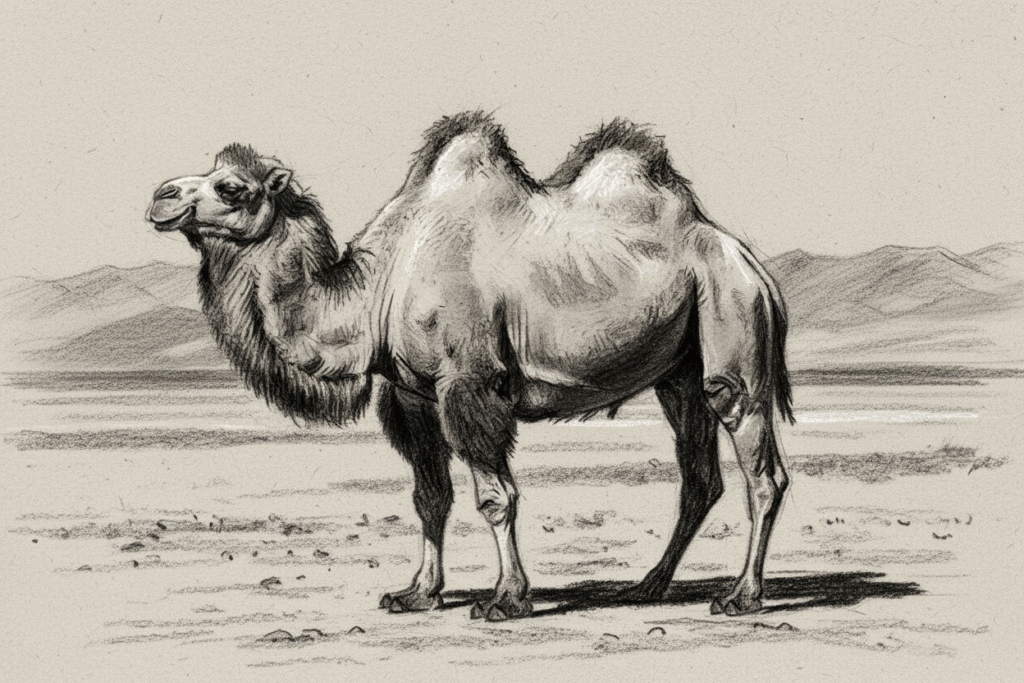
In the past, a so-called “trailer” would follow behind camels and pick up the naturally shedded fibers after the winter months have passed. This moulting process takes roughly 6 to 8 weeks. In some cases the camel’s hair is sheared all at the same time before it is ready to be harvested, although in most cases Bactrian breeders with generational experience usually predict exactly when the hair will naturally start falling out in the beginning of spring.
Once all hair has fallen or been shorn off, it is cleaned to remove impurities and is carded. Carding is the process of separating hair fibers into strands. In many cases, the same tools that have been used for millennia are still used to card camel wool today.
Camel hair is separated into three grades. The finest hair derived from the undercoat is considered high-grade. Only the best undercoat fibers are considered high-grade. These are the fibers that are most commonly used to make consumer textiles. Undercoat fibers that are not considered as high-grade are usually referred to as medium-grad fibers. These fibers may also be used to make apparel although they tend to be rougher to the touch than high-grade derived garments and usually need to be blended with sheep wool. The camel hair fibers from the guard coat are classed as low-grade. Low-grade camel hair fibers are too rough and inflexible compared to the other two grades and are therefore only suited for carpets and similarly rigid textiles. The yield obtained by shearing, combing and collecting during the moulting season average from 3.5 kg to 7 kg.
The use of camel hair to make garments have experienced a recent renaissance among the sustainably-minded consumer population since Bactrian camels naturally shed their winter coats every spring while most other types of wool can only be yielded by shearing. Therefore harvesting camel hair is usually a sustainable and cruelty-free enterprise.
Poor farming practices can result in excessive amounts of manure and other toxins entering the soil, causing contaminated waterways.
Untreated camel hair fiber is completely compostable. Things like dye, toxic chemicals, blended fibers and trims can hinder compostability.